Publications
2025
- Published
 Artificial Intelligence-Driven Development in Rechargeable Battery Materials: Progress, Challenges, and Future PerspectivesQingyun Hu, Junyuan Lu, Jian Hui, Ziyuan Rao, and 2 more authorsAdvanced Functional Materials, Dec 2025
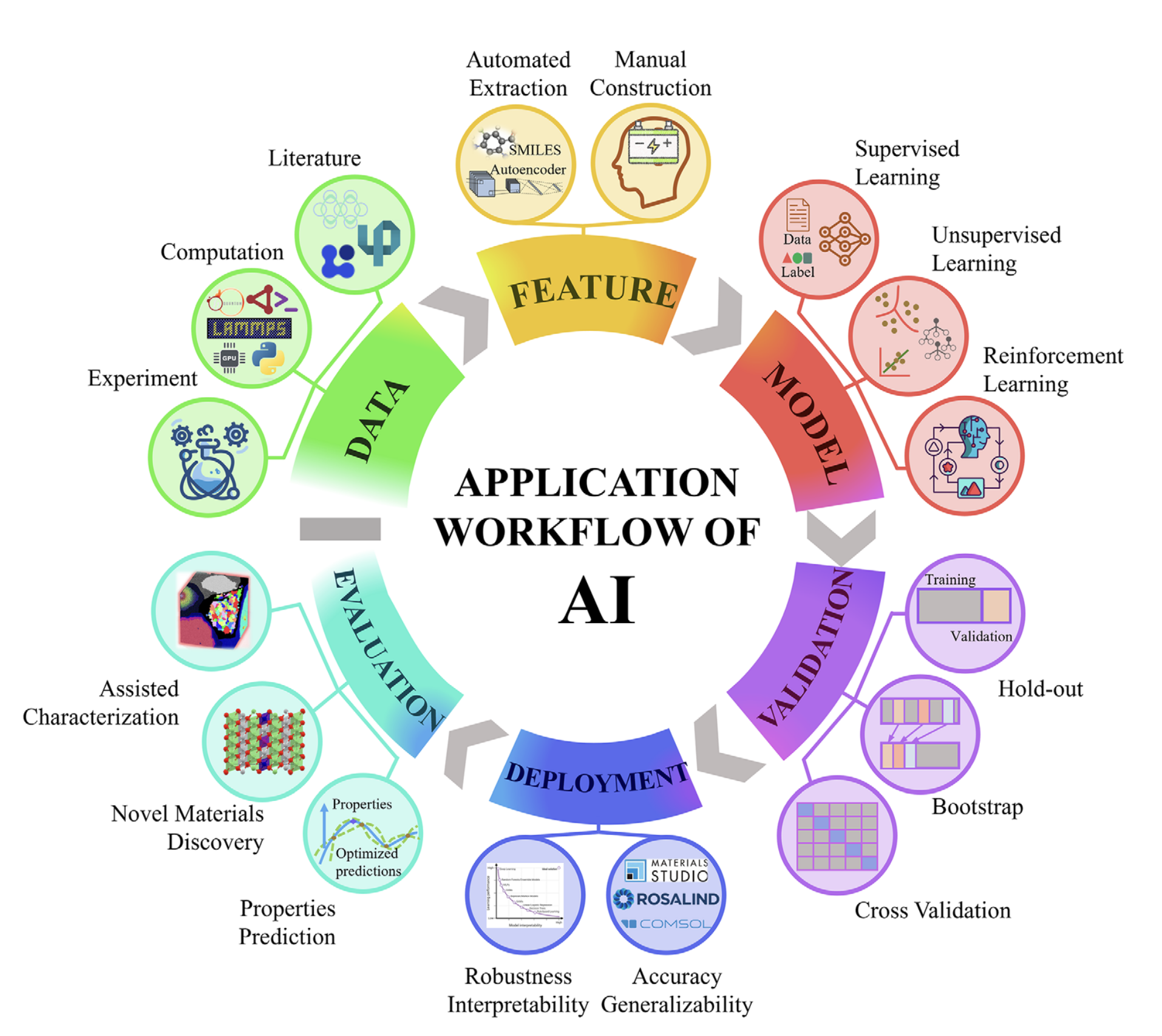
The integration of artificial intelligence (AI) into materials science has catalyzed a transformative revolution in energy storage technology, particularly in the development of advanced rechargeable battery systems. This paradigm shift is redefining traditional approaches to battery materials innovation by the emergence of AI-driven methodology. The review commences with an overview of typical algorithms and workflows integrated in the design and optimization of rechargeable battery materials in recent years. Subsequently, the cutting-edge applications of AI in the development of anode, cathode, liquid electrolyte, and solid-state electrolyte materials are reviewed. The key performance metrics and application characteristics are summarized, and the most recent and innovative milestones are highlighted, emphasizing the ability of the AI-driven method to solve complex multi-parameter coupling relationships. Meanwhile, this paper briefly discusses the critical challenges impeding the full realization of AI’s potential in battery innovation, including data scarcity, data quality, and model interpretability. Finally, the review outlines future directions for AI-powered closed-loop autonomous materials discovery systems, proposing a visionary framework that integrates high-throughput experimental and computational platforms, standardized databases, physics-informed algorithms, and explainable AI protocols. This synthesis of cross-disciplinary expertise positions AI not just as an optimization tool but as a paradigm-shifting force in the energy storage field.
- Published
 High-Throughput Screening of High Energy Density LiMn1-xFexPO4 via Active LearningQingyun Hu, Wei Wang, Junyuan Lu, He Zhu, and 4 more authorsChinese Chemical Letters, Feb 2025
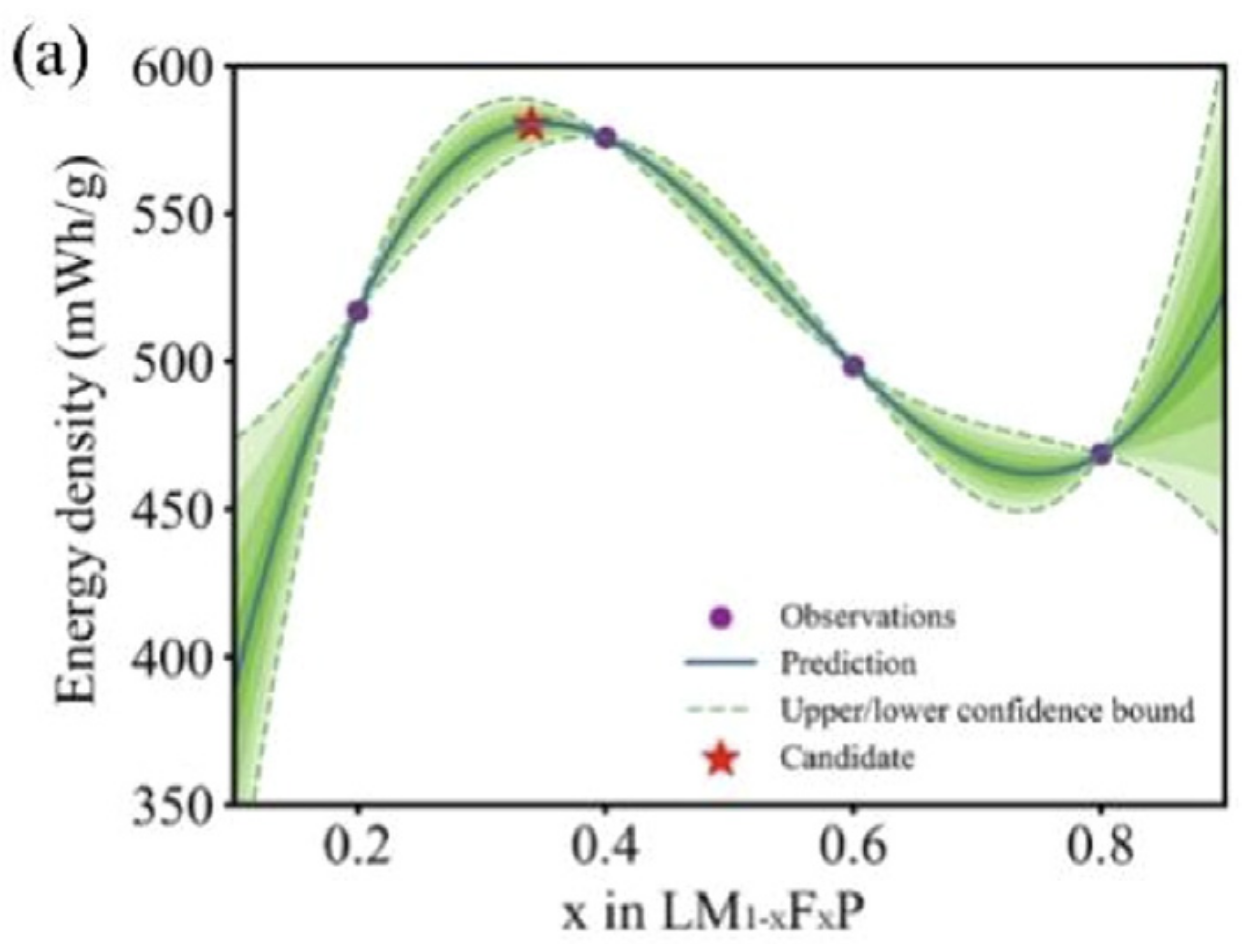
Lithium-ion batteries (LiBs) with high energy density have gained significant popularity in smart grids and portable electronics. LiMn1-xFexPO4 (LMFP) is considered a leading candidate for the cathode, with the potential to combine the low cost of LiFePO4 (LFP) with the high theoretical energy density of LiMnPO4 (LMP). However, quantitative investigation of the intricate coupling between the Fe/Mn ratio and the resulting energy density is challenging due to the parametric complexity. It is crucial to develop a universal approach for the rapid construction of multi-parameter mapping. In this work, we propose an active learning-guided high-throughput workflow for quantitatively predicting the Fe/Mn ratio and the energy density mapping of LMFP. An optimal composition (LiMn0.66Fe0.34PO4) was effectively screened from 81 cathode materials via only 5 samples. Model-guided electrochemical analysis revealed a nonlinear relationship between the Fe/Mn ratio and electrochemical properties, including ion mobility and impedance, elucidating the quantitative chemical composition-energy density map of LMFP. The results demonstrated the efficacy of the method in high-throughput screening of LiBs cathode materials.
- Published
 High-Throughput Screening of Superlattice-like Ge-Sb-M (M = Sn, Se) Thin Films for Multi-Level Phase Change Photonics MaterialsHongjian Yuan, Junyuan Lu, Genmao Zhuang, Hong Wang, and 1 more authorMicrostructures, Apr 2025
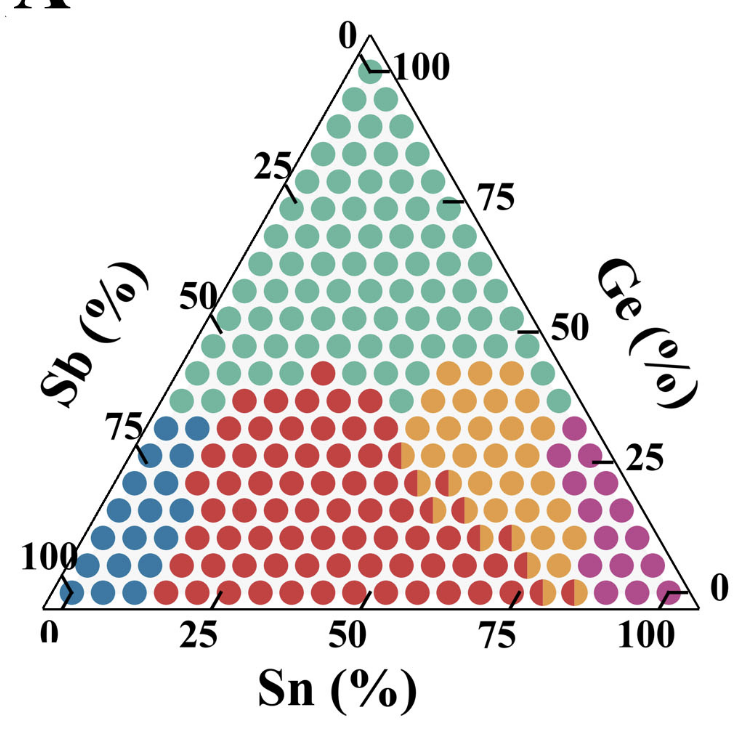
Ge-Sb-Sn/Se with a superlattice-like structure (SLL) is a promising material candidate for multi-level phase change photonics memory technology. However, its multi-stage phase transition process has not been elucidated so far due to the limitations of traditional research approaches. The most critical issue is to efficiently construct its composition-process-structure-property multi-parameter coupled constitutive relationship. In this work, we develop a high-throughput approach to systematically study the multi-level phase transition mechanisms of Ge-SbSn/Se SLL combinatorial thin films. For the Ge-Sb-Sn system, phase evolution is observed from trigonal to hexagonal/tetrahedral structures. In contrast, the Ge-Sb-Se system behaves differently. We further examine the optical properties of the Ge-Sb-Sn/Se SLL combinatorial thin films. The results identify the GeSbSn3 SLL thin film as a standout from the Ge-Sb-Sn ternary system under Sb→Sn→Ge deposition sequence, with a figure of merit (FOM) greater than 0.4 and high thermal stability. The present study serves as a foundation for further exploration of the Ge-Sb-based quaternary system and accelerates the application of advanced phase change materials (PCMs) in the big data era.